End of Days
Handling the UndeadThe End of Days is the apocalyptic possibility Elvy uses to make sense of the dead’s return and the prospect that ordinary life may be ending. It takes shape through biblical prophecy, a vision of the Virgin Mary, and a storm that gives a group of believers reason to gather. But the approaching end is never confirmed: Elvy can urge preparation and call a vigil while still admitting that she does not know what the signs mean.
Signs and Prophecy
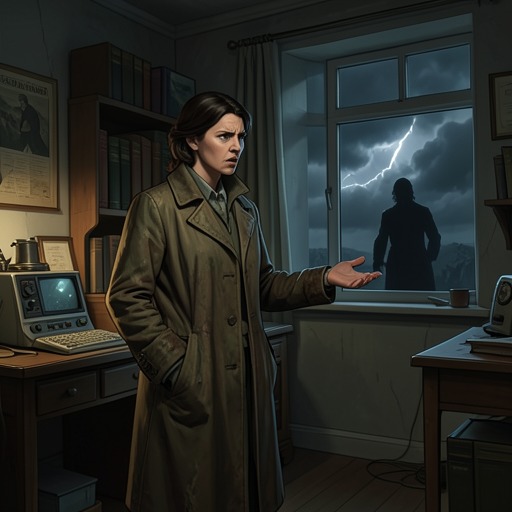
Dark thunderclouds first make the possibility of an ending feel immediate to Elvy. They are not the soft summer clouds that merely set off a blue sky, but heavy banks moving so slowly that they seem still. The sight gives her a tingle in her stomach and prompts the anxious question of whether this is how it will look. She wanders around the house, yawning and trying to prepare, but preparation has no clear object or method.
That uncertainty turns her toward scripture. Elvy sits in her reading chair and looks up Matthew 24 because she has forgotten the rest of the passage. The verses she reads instruct a person on a housetop not to go back inside for possessions, and a person in the field not to return for clothes. The image makes the anticipated crisis one in which ordinary belongings must be abandoned; there may be no safe pause to collect them. The passage then describes a tribulation without precedent, while promising that, for the elect’s sake, those days will be shortened.
The prophecy does not reassure Elvy so much as give her fear a scale. As she reads about great tribulation, she sees concentration camps and Flora. These images link biblical catastrophe with human suffering and with someone close to her, rather than leaving the end as an abstract religious prediction. The promised shortening of those days stands beside, but does not erase, the horrors her imagination has supplied.
The Virgin Mary and the Meaning of Tribulation
Elvy’s scriptural apprehension becomes a vision when the television turns on and wakes her. Its intense light first shines through her closed eyelids; when she opens her eyes, the screen is so bright that she has to shut them again, then look tentatively. As her sight adjusts, she recognizes a woman at the center of the radiance: the Virgin Mary. The apparition makes the language of tribulation visible in a figure Elvy already understands.
Mary wears a dark blue shawl over black hair. Her eyes hold the grief of a mother who has seen her child die: the image evokes the foot of the cross, the nails being pulled from her son’s hands, and the damage done to the small hands once eager for her breast. Elvy whispers a reverent recognition and cannot bear to look. What she understands in Mary’s expression is not only a mother’s pain at the torture and execution of a cherished child, but the deeper anguish of living in a world where such suffering can happen. The vision therefore gives the End of Days an ethical and emotional meaning: tribulation is not simply a timetable of supernatural events but the recognition of what the world permits its most innocent to endure.
A Message to Prepare
Elvy carries her interpretation beyond private reading and vision. When she tells a man that they have come to prepare him, he asks what for. She answers that they are preparing for the return of Jesus Christ, then connects that expectation to the present crisis: the dead have arisen, as he has probably heard. His widened eyes register the force of the claim, although the exchange does not establish that he accepts it. Elvy presents the return of the dead as a sign within a Christian expectation, not as proof that she can specify exactly what will follow.
This distinction matters to the way Elvy speaks about the end. She can name an expected return and interpret the dead’s arising through it, yet the evidence does not show her possessing a complete account of the future. Her religious language gives the crisis direction and makes preparation a task she can undertake; it does not remove uncertainty. The End of Days is thus both a forecast Elvy shares and a question she continues to face.
Storm, Gathering, and Vigil
A later storm brings that uncertainty into a communal setting. Hagar jokes about the apparent horses of the apocalypse as she and Elvy struggle through the rain. The downpour makes breathing difficult, and they move slowly under buckling umbrellas. Lightning strikes just as they reach Elvy’s house, followed seconds later by thunder. Hagar asks whether this is the End; Elvy smiles crookedly and answers that Hagar’s guess is as good as her own. Her reply keeps the apocalyptic possibility open without presenting the weather as a certain omen.
Others arrive at the house, including a woman carrying candles in case they have none and Mattias, who has a computer background. He has considered bringing his laptop, but sees no point while the storm continues. With the visitors gathered in the living room, candles lit, coffee poured, and pastries served, they explain why they came. Once the thunder has eased, Hagar can turn up her hearing aid and participate. The group agrees that the storm has driven home the prospect that the night could bring the world’s end, or at least a complete change to life as they know it. They do not want to sit alone when they can gather with people who share their concerns.
Their response changes the meaning of preparation from an individual effort to a practice of mutual presence. When the visitors look to Elvy, she says that faith lives only when shared, and proposes sitting vigil through the night. If it proves to be the last, they will meet it together, hand in hand. The group cannot resolve whether the End of Days has arrived; its vigil answers instead the immediate fear of facing that possibility alone. The apocalyptic expectation remains open, but companionship becomes a concrete way to endure its uncertainty.